
How to Choose the Right Dump Truck Configuration: 4x2, 6x4, or 8x4 Guide
Five categories of special commercial vehicles — every chassis configurable for your route, payload and regulatory environment.
Selecting the optimal dump truck (tipper truck) configuration is a key decision for civil contractors, quarry operators, and fleet managers. Matching driving layout, axle capacity, and horsepower to your specific payload requirements prevents premature mechanical failure, minimizes fuel consumption, and ensures compliance with local axle-load regulations.
Technical Comparison Across Drive Layouts
Dump truck configurations are defined by their total wheel positions versus powered wheel positions (A x B, where A = total wheels and B = powered wheels).
Breakdown by Configuration
1. 4x2 Single Rear Axle Dump Trucks
Operational Footprint: Highly maneuverable with short wheelbases (3,300–3,800mm), making them ideal for navigating narrow urban streets, residential construction sites, and small utility repairs.
Chassis & Powertrain: Light-to-medium-duty chassis (e.g., Foton, Dongfeng, ISUZU platforms) paired with 4-cylinder or small 6-cylinder diesel engines.
Limitations: Restricted payload capacity (5–12tons). Low traction on soft, muddy off-road surfaces compared to multi-axle drive systems.
2. 6x4 Double Axle Drive Dump Trucks
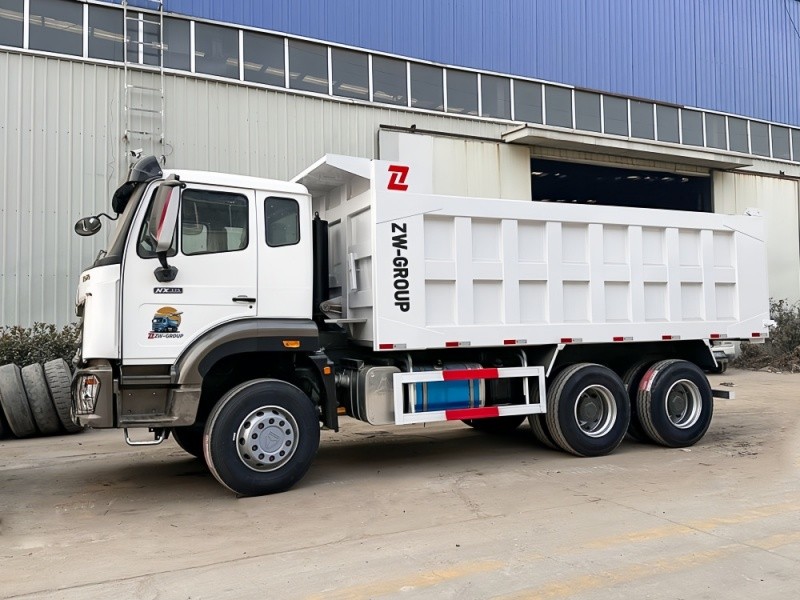
Operational Footprint: The global standard for heavy construction, road building, and medium-scale mining.
Chassis & Powertrain: Heavy-duty chassis (such as HOWO, SHACMAN, or FAW) powered by 9L to 12L engines (290–400HP). The rear tandem drive axles feature inter-axle and inter-wheel differential locks to maintain traction on unpaved gradient haul roads.
Structure & Hydraulics: Uses high-strength steel (Q345B, T700, or Hardox) dump bodies paired with front-mounted telescopic hydraulic cylinders (e.g., HYVA systems) for stable unloading.
3. 8x4 Twin-Steer Heavy-Duty Dump Trucks
Operational Footprint: Designed for maximum legal payload capacity on highway haulage, large-scale civil works, and open-pit mining operations.
Chassis & Powertrain: Four axles with dual front steering axles (2 x 9ton front axles) and heavy-duty hub-reduction rear axles (2 x 16 ton double reduction). Powered by 371–480 HP turbo-diesel engines.
Key Advantage: Distributes heavy static mass across four axles, maximizing volume (22–30m³) while staying within legal axle weight limits on paved roads.
Key Factors to Determine Your Configuration
Payload & Density: Heavy materials like wet sand, iron ore, or granite rocks require reinforced U-shaped or rectangular steel bodies on 6x4 or 8x4 chassis to prevent frame sagging.
Ground Clearance & Axles: For off-road mud or rock-filled quarry tracks, select hub-reduction axles for extra ground clearance and wheel-end torque. For highway aggregate transport, single-reduction axles provide better fuel efficiency.
Turn Radius vs. Stability: 4x2 trucks provide tight turning radiuses for city work. Multi-axle 6x4 and 8x4 trucks offer a wider footprint, lowering the vehicle center of gravity to prevent rollover accidents during high-angle dumping on uneven ground.

—— Request a Quote
Get a tailored quotation from ZW Group.
Tell us your requirements — we respond with pricing, specifications, and solutions.
Please give us a message